St Leonard’s Patronal Festival
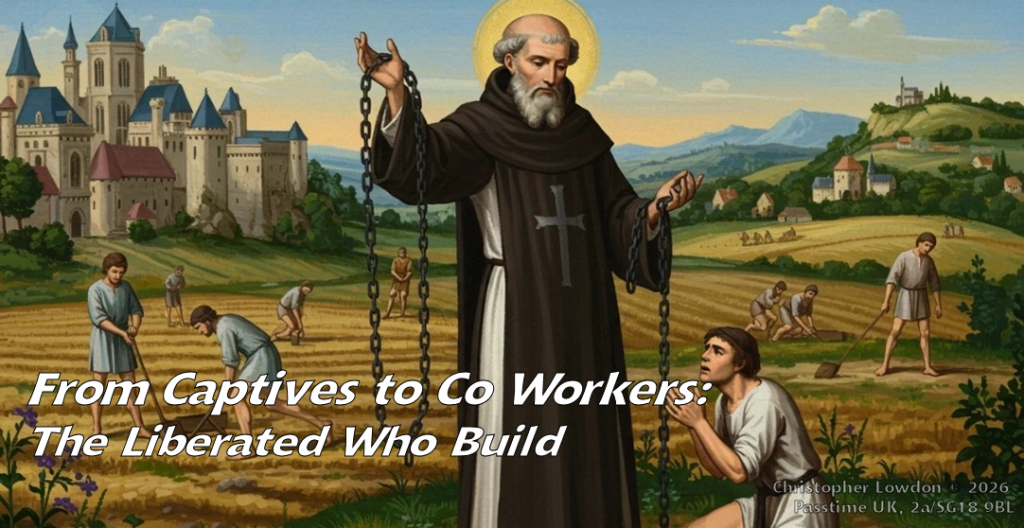
St Leonard was a 6th‑century hermit from the Limousin region of France. He was a nobleman, born into wealth but he walked away from privilege to follow Christ. He became known for his compassion toward prisoners. Tradition says Leonard was granted the privilege of visiting prisons and advocating the release of captives whom he deemed worthy of mercy by royal decree, and this early ministry shaped his lifelong mission of seeking justice for the oppressed.
But Leonard didn’t stop at release. He gave work to those whom he freed, clearing the forest around his hermitage and preparing them for employment and a life of honesty after their sentences. He created a place where people could begin again. That’s why he became the patron saint of prisoners, not just because he broke chains, but because he rebuilt lives.
The legends go on to say that miraculous releases from chains were granted to those who prayed to him after his death, and thus he was canonised as the patron saint of prisoners. Around 1100, when Old Warden’s church was founded, he was a very popular saint indeed, which is probably why they took him as its patron, even though we are a long way from the forests of Limousin, the centre of his work and ministry.
So we often remember Leonard as the saint who freed prisoners, the one whose prayers caused chains to fall off wrists and ankles. And that is fair enough – it’s what he’s famous for. There is a detail in his life that deserves more attention than it usually gets. Because liberation was only the beginning of his ministry.
He didn’t just free people; he employed them. He didn’t just release folk; he reconciled them. He didn’t simply open prison doors; he unlocked a future. He restored dignity. He built a community.
And that, I want to suggest, is the heart of today’s feast.
Not just freedom and release from whatever binds us but purpose and calling
Leonard didn’t just free captives. He formed co‑workers.
And that’s what our readings point us toward.
Isaiah 61 begins with a wonderful promise, the promise of liberation:
“The Lord has anointed me to proclaim liberty to the captives
and release to the prisoners.”
But it doesn’t end there. Isaiah goes on:
“They shall build up the ancient ruins;
they shall raise up the former devastations.”
The ones who were freed become the ones who rebuild.
The ones who were restored become the restorers.
The ones who were broken become the builders.
This is the biblical pattern:
God frees people in order that they may flourish.
God liberates in order that they may live.
God saves in order that they may serve.
Freedom is not the end of the story; it is the beginning of vocation.
I think Leonard understood that. He didn’t simply release folk from chains; he created the conditions in which people could grow into the fullness of life God intended for them. He believed that the freed have work to do: holy work, restorative work, kingdom of God work.
Turning to Acts, we get a vivid picture of this transformation in action.
Paul and Silas are imprisoned, singing hymns in the night. The earthquake comes, the doors fly open, the chains fall off. But notice what happens next. It’s not just Paul and Silas who are freed.
The jailer, terrified, asks, “What must I do to be saved?”
And by the end of the story, he and his whole household are baptised.
But the most striking detail is this: the jailer washes their wounds.
He is freed and becomes a co-worker himself. The man who once held the keys now holds a bowl of water. He tends and serves the apostles, and (by extension) serves Christ as well
Because that’s part of what Matthew 25 teaches us.
In Matthew 25, Jesus describes the final judgement not in terms of doctrine or ritual, but in terms of service: It’s not how often you come to church, or how often you pray or how well you know your Bible or even how much you put on the collection plate – none of which are bad things, but it’s not what Christ is interested in. The exam at the end of time has one question: How good were you at serving others?
- I was hungry, and you gave me food.
- I was thirsty, and you gave me drink.
- I was a stranger, and you welcomed me.
- I was in prison, and you visited me.
These aren’t dramatic acts. They’re simple, human, everyday acts of compassion. And Jesus says, “When you did these things for the least of these, you did them for me.”
In other words, the Church is not simply called to break chains of sin and anything else that imprisons people (though that matters), but to create a community where the vulnerable are honoured, the lonely are welcomed, and the wounded are tended.
The righteous in Matthew 25 are those who used their freedom to serve.
This is the heart of Christian vocation:
the liberated become the servants of Christ.
This is why Leonard is such a good patron for a parish. He didn’t just do the headline-grabbing miracles. He did the slow, patient, restorative work of helping people begin again, preparing them to become servants of Christ.
I think he understood that
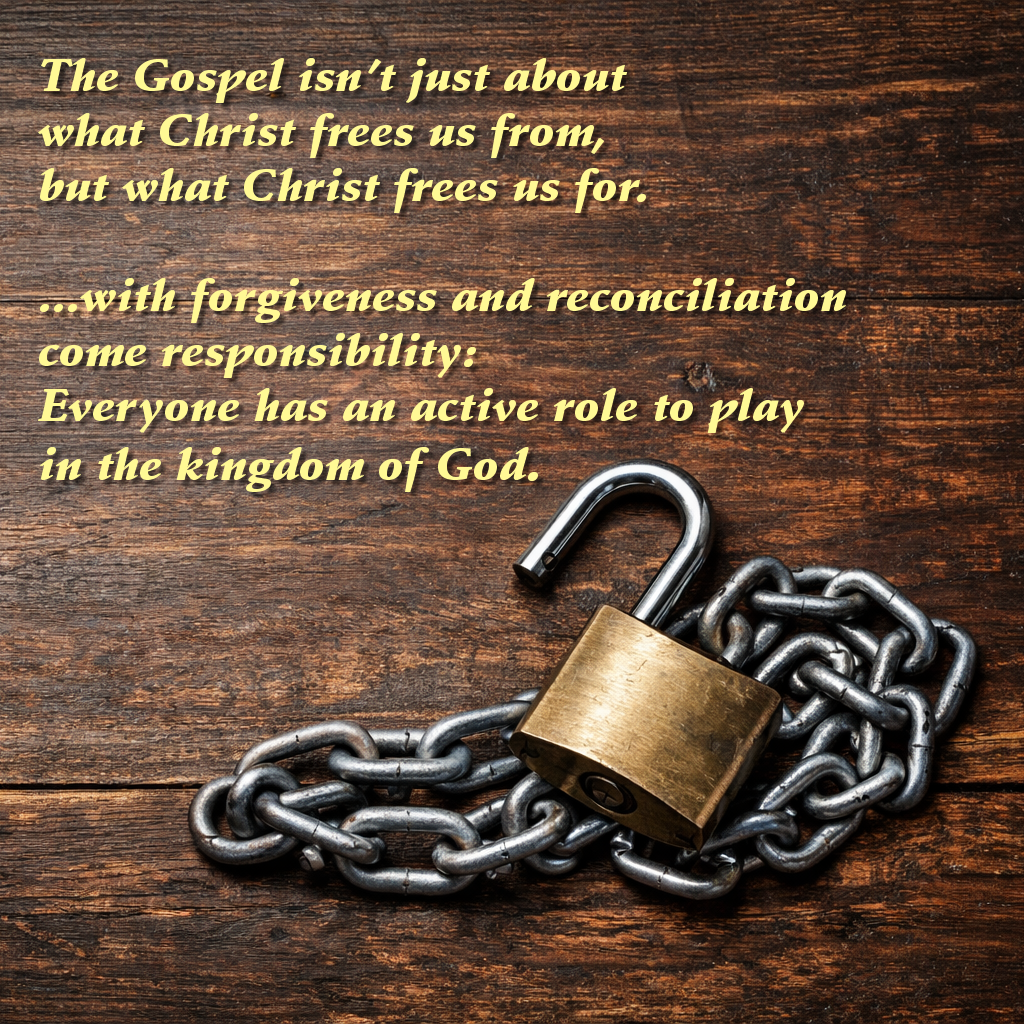
the Gospel isn’t just about what Christ frees us from,
but what Christ frees us for.
And that is perhaps why his cult spread so widely. People recognised in Leonard not so much as a miracle-worker, but a man who understood the heart of the Gospel: that God’s love is always moving toward the broken, the bound, the forgotten – not simply to free them, but to call them to serve.
Everyone has the potential to be liberated – freed from sin – but with forgiveness and reconciliation come responsibility: Everyone has an active role to play in the kingdom of God.
And that brings this back to us.
We’re not here simply to admire St Leonard.
We’re called to take up the work he began.
We’re here to be a community where:
- the lonely find friendship,
- the anxious find peace,
- the grieving find comfort,
- the wounded find healing,
- the lost find home.
We’re here to be a place where people can begin again.
And we can only do that together.
Leonard didn’t do it alone.
Paul and Silas didn’t do it alone.
The early Church didn’t do it alone.
Even Jesus didn’t do it alone.
We need one another.
We need each other’s gifts, prayers, strengths, and compassion.
At the end of every Eucharist, or (to use an alternative word for that service) at the end of every Mass, we hear the words:
“Go in peace to love and serve the Lord.”
Not “Go in peace to live a life of ease.”
But “Go in peace to love and serve.”
The reason I mention the Mass is that this phrase is where that word comes from. The Latin for this phrase is Ite missa est: roughly, it means, “Go out, you are sent from here, but with a purpose”. (It’s also the root of “dismissal”, which is also to be sent out with a purpose, and in our service books, we call this section The Dismissal). Sent out, with a mission. And calling it The Mass reminds Catholics of this, their duty to go out and serve. Calling this section The Dismissal should remind us of the same.
To serve whom?
The hungry, the thirsty, the stranger, the sick, the imprisoned — the very people Leonard served, the very people Jesus identifies himself with.
So today, as we honour our patron, let us also take up his mantle.
Let us be a community where we, the liberated, become the builders.
Let us be a place where people can lose their burdens and begin again.
Let us be a people who use our freedom for the sake of others.
Because the world is full of those who need a fresh start.
And Christ has placed us here — in this benefice, in this season, in this moment — to be his hands and feet.
The chains may fall in an instant.
But the rebuilding takes a lifetime.
And that is the holy work to which we are called.
Amen.